Choosing tires for a truck you also drive home
The compromise most truck owners actually need, and where the aggressive tire stops making sense.
September 7, 2026 · 3 min read
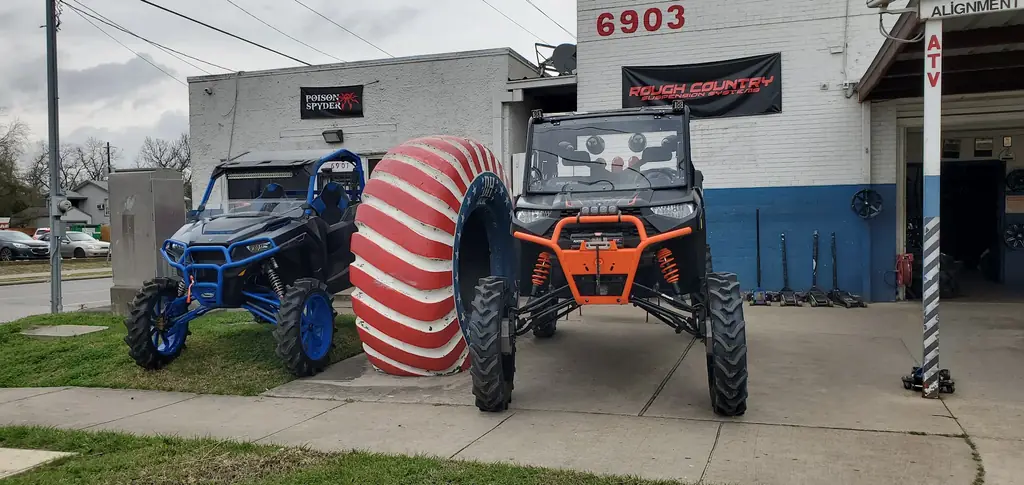
A lot of trucks in Houston do two jobs. They carry weight or tow during the week, and they are the family vehicle at the weekend. Buying tires for that is a genuine compromise, and the two most common mistakes are opposite: buying a tire that cannot carry what the truck carries, and buying an aggressive off-road tire for a truck that almost never leaves pavement.
Load rating first, everything else after
If the truck carries or tows, start with the load index and work back from there. This is the one specification you do not compromise on.
A tire rated below what the vehicle needs is being overworked every time the truck is loaded, and the failure mode is heat inside the casing rather than anything you would see on the outside. It is worth checking what the truck actually calls for rather than assuming the tires currently on it are correct, because used trucks frequently arrive wearing whatever was cheapest at some point in their history.
You will also see load range letters, commonly C, D or E, on light truck tires. Higher letters mean stiffer construction and a higher pressure rating. A heavier rating rides firmer when the truck is empty, which is the trade-off, but on a truck that regularly works it is the right call.
How aggressive does the tread really need to be
This is where most of the money gets wasted. Mud terrain tires look the part and they genuinely work in mud, but on a truck doing five thousand freeway miles a year they are the wrong tool.
The large gaps between the tread blocks that clear mud so well also mean less rubber touching the road. On pavement that means more noise, longer stopping distances in the wet, and faster wear because the blocks squirm under load. If your truck goes off pavement occasionally rather than routinely, an all terrain tire will do everything you need and be considerably more pleasant to live with.
- Mostly pavement, occasional site or trail: all terrain
- Genuinely off road most weeks, mud and loose ground: mud terrain
- Almost entirely freeway and towing: a highway tire will outlast both and stop better in rain
The lifted truck problem
If the truck is lifted, tire choice stops being just about the tire. Fitting larger tires under a lifted truck is easy. Fitting them so they do not rub at full lock or full articulation, and so the steering geometry still works, is the part worth paying attention to.
Wheel offset and backspacing decide where the tire actually sits in the arch, and getting those wrong shows up as rubbing, fouled brake components, or a stance that quietly loads the wheel bearings harder than they were designed for. It is much easier to get this right before the parts are bought than after.
Where used tires make sense, and where they do not
We stock used tires and we are straightforward about when they are the right answer. If a vehicle is close to being sold, or a budget genuinely will not stretch this month, a sound used tire with real tread left is a much better outcome than driving on something bald.
Where they stop making sense is on a truck that carries weight. The load rating still has to be correct, and the history of a used truck tire matters more, because a casing that has been run flat or badly under-inflated at some point in its life is compromised in ways nobody can see from the tread.
Making the set last
Rotate on schedule, check pressures cold once a month, and align the truck when the new set goes on rather than afterwards. On a working truck, pressure is worth checking more often than monthly, because the correct pressure loaded and unloaded are not the same number.
One last thing worth reading before you buy: the mileage figure on a tire is a treadwear warranty, not a promise, and it is usually written on the assumption that the tire is rotated on schedule and kept at the right pressure. Skip either and the figure means very little, which is another reason the cheap maintenance matters more than the expensive purchase.
Come and talk it through at 6903 Lyons Ave, or call (713) 234-0629 and we will work out sizes and pricing over the phone. In-house financing is available if the timing is awkward, which on a set of truck tires it often is.
D H Tire, Inc, (713) 234-0629
Call (713) 234-0629More articles
What the numbers on your tire actually mean
Everything you need to give us over the phone is already written on the side of the tire you have.
When a flat tire can be repaired, and when it cannot
The honest version, including the cases where we will tell you the tire has to be replaced.