Pulling or shaking: is it alignment or balance?
They feel different, they are caused by different things, and describing yours accurately saves time and money.
September 7, 2026 · 4 min read
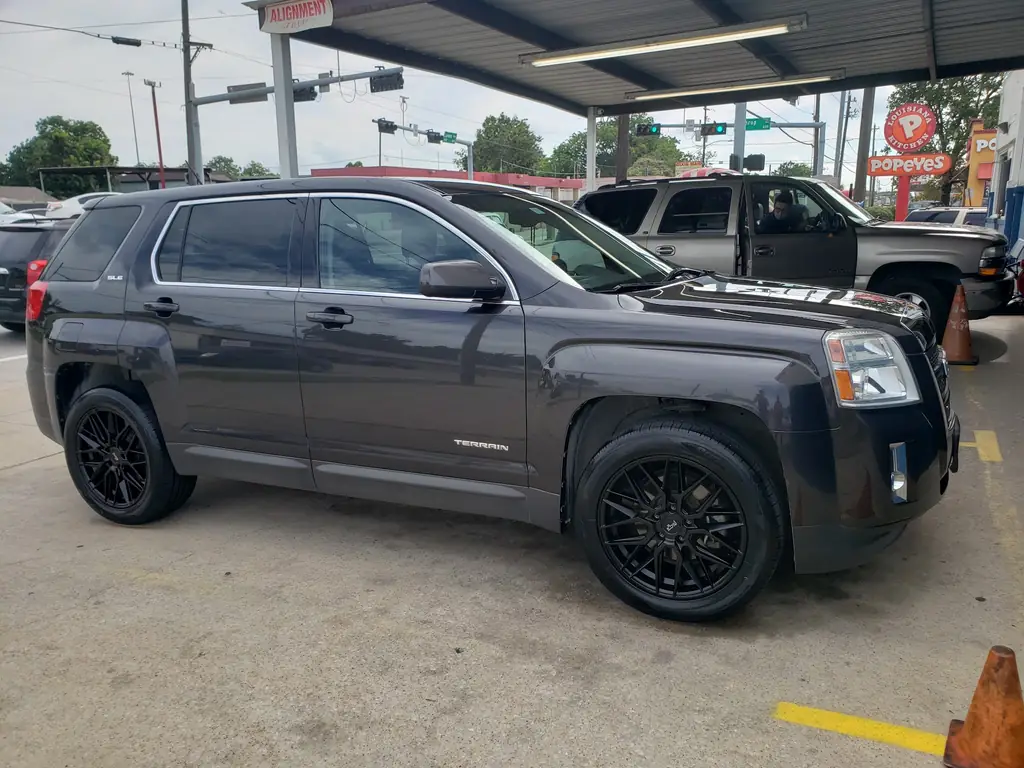
Alignment and balancing get talked about as if they were the same service. They are not related at all. One is about the angles your wheels sit at, the other is about weight distribution around a spinning wheel, and knowing which one you have is worth doing before you call anyone.
Balance: a shake that appears at speed
A wheel and tire assembly is never perfectly even in weight. Balancing corrects that by adding small weights to the rim until the assembly spins true.
When it is out, you get vibration, and the giveaway is that it is speed dependent. It typically is not there at thirty miles an hour, it appears somewhere around fifty or sixty, and it may actually smooth out again if you go faster still. If you feel it mostly through the steering wheel, the front wheels are the likely culprits. If you feel it through the seat and the floor, look at the rear.
Balance goes out for ordinary reasons. A wheel weight falls off. A tire is fitted and not balanced properly. Mud packs into the inside of the rim. It is quick work to put right.
Alignment: a pull that is there all the time
Alignment is the set of angles the wheels sit at relative to the road and to each other. The names for them are toe, camber and caster, and toe is the one that eats tires fastest.
The symptoms are different in character from a balance problem. The vehicle pulls steadily to one side on a flat, straight road. The steering wheel sits crooked when you are actually going straight. And critically, it does not care what speed you are doing. A pull at thirty is a pull at seventy.
The other symptom is on the tires themselves. A tire that is being dragged slightly sideways every rotation wears unevenly across its width, and the edge that is taking the load goes first.
- Vibration that appears above about fifty: balance
- Pull or crooked wheel at any speed: alignment
- One shoulder worn, the other fine: alignment
- Both shoulders worn evenly, centre fine: under-inflation, not either of these
How a car goes out of alignment
Kerbs and potholes, mostly. Nothing dramatic has to happen. A firm hit into an unseen pothole is enough to move the geometry far enough to start costing you tread, and Houston road surfaces provide plenty of opportunities.
Worn suspension components do it too, and that matters when you book the work, because an alignment set on a car with a worn tie rod end or a tired bushing will not hold. There is no sense paying for an alignment that will not survive the month, which is why the suspension gets looked at while the car is up.
The timing that saves you money
Get the alignment done when you fit new tires, not afterwards. This is the single most useful piece of timing in the whole subject.
Fitting a new set to a car whose geometry is still out means the new tires immediately start wearing in exactly the pattern that finished the old ones. People do this constantly, then come back eighteen months later assuming they bought bad tires. They did not. They bought good tires and fed them to a fault nobody corrected.
The same logic applies to a lifted truck. Raising a truck changes the suspension angles by definition, so alignment is part of that job rather than an afterthought.
When it is neither of them
A couple of other faults imitate these two closely enough to be worth ruling out. Road crown is the simplest: most roads are built with a slight camber so water runs off, and a vehicle will drift gently towards the kerb because of it. If the pull disappears when you change lanes or drive on a genuinely flat surface, the car is fine and the road is doing it.
Tire pull is the other one. Occasionally a single tire is built with a slight internal bias that makes it pull to one side regardless of alignment. The tell is that swapping that tire to the other side of the vehicle moves the pull with it. It is uncommon, but it is worth knowing about before anyone starts adjusting geometry that was never out.
A brake dragging on one side will also pull, and that one usually comes with heat or smell from that wheel after a run. That is a different job, and a more urgent one.
What to say when you call
Describe the behaviour rather than naming the fix. Tell us whether it pulls or shakes, at what speed it happens, and whether the steering wheel is straight when the vehicle is going straight. That is usually enough for us to know what we are looking at before the car arrives.
The Automotive Center on Lyons Ave handles alignment for cars, trucks and SUVs on (713) 234-0629. Front-end alignment for tractor-trailers runs out of the commercial side on (346) 741-5592.
D H Tire, Inc, (713) 234-0629
Call (713) 234-0629More articles
What the numbers on your tire actually mean
Everything you need to give us over the phone is already written on the side of the tire you have.
When a flat tire can be repaired, and when it cannot
The honest version, including the cases where we will tell you the tire has to be replaced.